Real estate CRM software for builders & developers From first enquiry to registration.
AuraStack is a real estate CRM built only for Indian builders and developers. Leads, site visits, unit inventory, bookings, collections and channel partner payouts sit in one system — so your sales floor, site team, partners and accounts work from the same numbers.
We use these details only to set up your trial and call you about it.
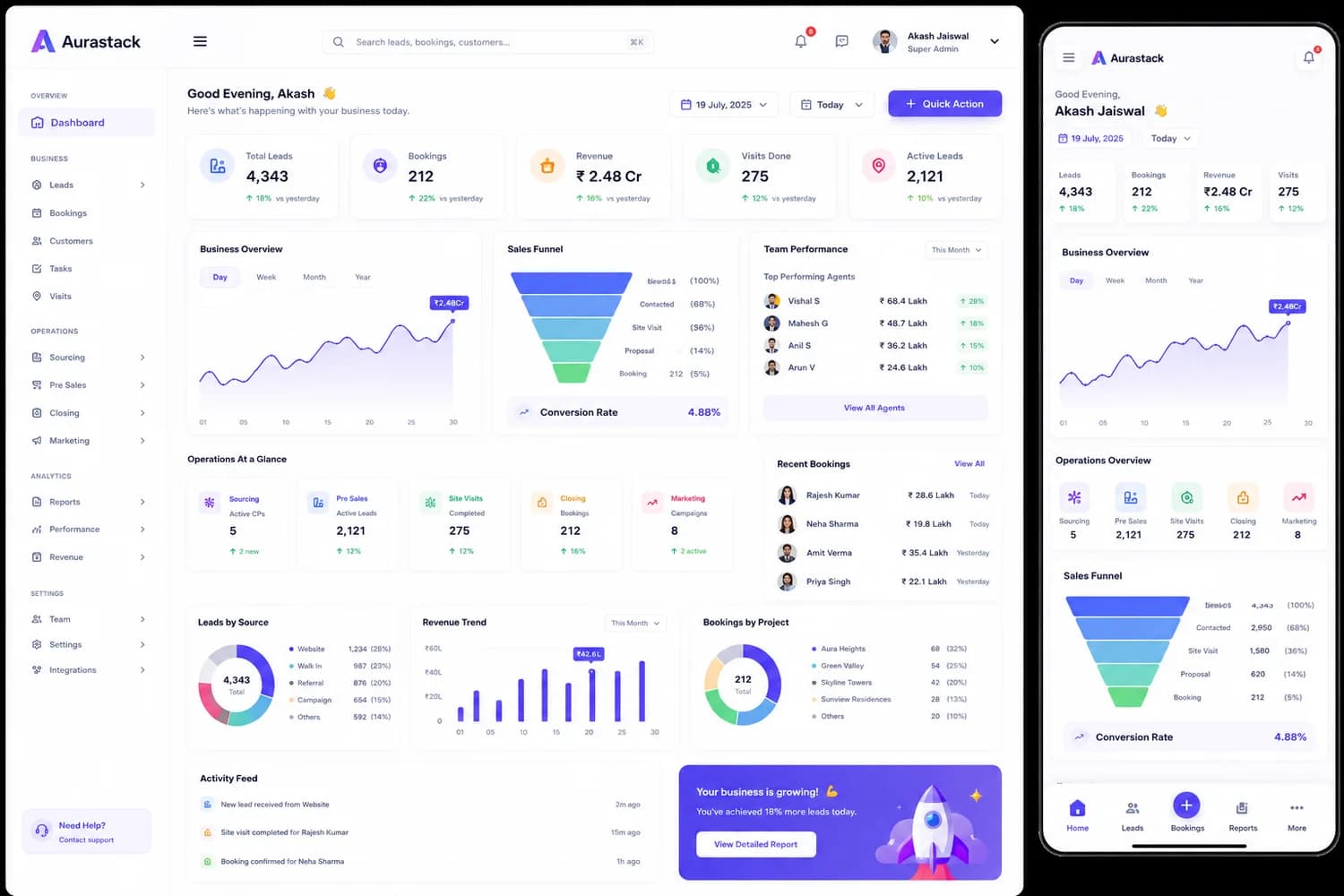
01/06The short answer
What a real estate CRM actually does.
A real estate CRM is the system a builder’s sales, site, channel-partner and accounts teams share to move every buyer from first enquiry to registration. Unlike a generic CRM, it knows what is being sold — projects, wings and units — and what happens after the yes: the booking, the payment plan and the collections.
What you sell
In a generic CRM
Contacts and deals. Units become a custom object you build and maintain.
In AuraStack
Projects, wings and units, with a live price matrix.
Holding a unit
In a generic CRM
A status someone has to remember to clear.
In AuraStack
A hold that expires on its own.
After the booking
In a generic CRM
The deal is marked won and the payment schedule moves to Excel.
In AuraStack
Cost sheet, eight-stage payment plan, demand letters and collections.
Site visits
In a generic CRM
A calendar event.
In AuraStack
Visits booked against the lead, WhatsApp reminders and a no-show rate.
Channel partners
In a generic CRM
Another contact type, usually without a login of their own.
In AuraStack
Partner logins that see only their own referrals, with buyer data masked.
Pricing
In a generic CRM
Usually per user — every site executive and partner is another seat.
In AuraStack
Per company, so the bill does not grow with the team.
02/06Stage by stage
The whole sale, in one system.
Eight hand-offs decide whether an enquiry becomes a registration. This is what AuraStack does at each one.
- 01
Enquiry
WhatsApp, Meta and Google lead forms, LinkedIn Ads, SMS, email, walk-ins and channel partners land in one lead list.
- 02
Calls & follow-up
Company Android phones sync their call logs to the right lead, and an unanswered call books its own retry for the next morning.
- 03
Site visit
Visits are booked against the lead, reminders go out on WhatsApp, and the no-show rate sits on the owner dashboard.
- 04
Unit hold
Pick the unit on a live inventory grid. The hold carries its own expiry, so stock never stays blocked by a rep who went quiet.
- 05
Booking
Upload the cost-sheet PDF and the buyer, unit and agreement value fill themselves. The booking gets its eight-stage payment plan.
- 06
Collections
Demand letters go out against the plan, payments are verified maker-checker, and anything overdue surfaces on the owner dashboard.
- 07
Partner payout
Brokerage is computed against confirmed bookings — slab, flat or percent — and every partner can see what they have earned.
- 08
Registration
Registrations due sit on the closing desk, and every change to the booking stays in the audit trail.
03/06Every desk
One platform, six different jobs.
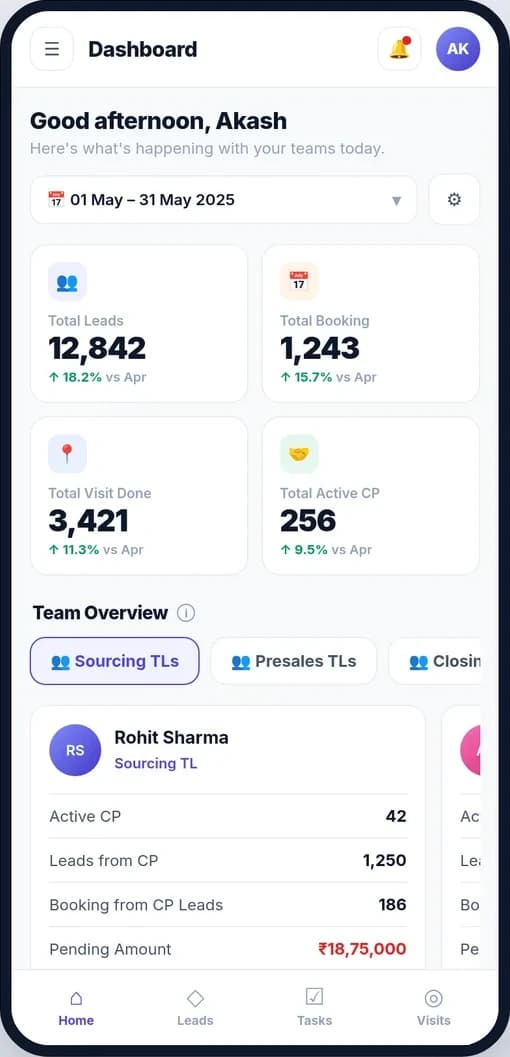
A builder’s sale runs through very different people. Each one gets the screen their job needs — and only the data their role allows.
Owner · Director
Five numbers on one screen: booked value, collected, live pipeline, partner payout due, and buyers who visited and walked away.
Sales head
A dashboard per team lead. Sourcing, pre-sales and closing each get their own scoreboard and working tiles.
Pre-sales & tele-calling
Calls made, visits booked and conversion, with call logs synced from company phones — no telephony contract.
Site & closing team
Visits to run, negotiations stuck 30 days or more and registrations due, on the phone they already carry.
Accounts & post-sales
Payment plans, demand letters and maker-checker payment verification, with incentive payouts exported to Excel for finance.
Channel partners
Their own login: their referrals, their visits, their brokerage. Every other buyer stays masked.
How partner logins work
04/06Before you buy
Eight questions to ask any real estate CRM.
There is no single best CRM for every builder. The right one answers these well for your projects — here is how AuraStack answers them.
- 01
Does it model inventory, or only contacts?
AuraStack
Projects, wings and units, a price matrix, six unit states and holds that expire on their own.
- 02
Can a channel partner log in safely?
AuraStack
Yes. A referral data scope, with phone, email and deal value masked per role.
- 03
Does a booking turn into collections?
AuraStack
Cost sheet, an eight-stage payment plan, demand letters and maker-checker payment verification.
- 04
Are incentives computed, or kept in Excel?
AuraStack
Computed from confirmed bookings, with targets cascaded from company to region, team lead and RM.
- 05
Will the site team actually use it?
AuraStack
It runs on the Android phones they already carry, with one-tap call and WhatsApp on every lead.
- 06
Is every change on record?
AuraStack
Old value, new value, user, role and IP for every change — including the actions that were denied.
- 07
What happens to the bill when the team doubles?
AuraStack
Nothing — it is priced per company. At a per-seat rate of ₹2,599 a month, 40 users would cost ₹12.5 L a year.
- 08
Will they migrate your sheets — and let you leave?
AuraStack
Leads, the CP list and visit history move before your first login, and a full export is yours on request.
05/06Cost & switching
Priced per company. Live in a week.
No seat maths and no six-month implementation. The figure is quoted on a short call; the structure is right here.
Priced per company, not per user
Put your whole sales floor, your site team and your channel partners on it without watching a seat counter.
30-day trial on the full product
Not a stripped demo tenant. Your projects, your leads, your team, everything switched on.
Migration is included
Your lead sheets, channel-partner list and site-visit log are imported before your first login.
Leave with everything
A full export of your data on request. No hostage-taking, no exit fee.
06/06Straight answers
Questions builders ask before they switch.
What is a real estate CRM?
One system for the whole property sale.
A real estate CRM is software a builder or developer uses to run the whole property sale in one place: enquiries from every source, follow-up calls, site visits, unit inventory and holds, bookings, payment plans and collections, channel partner brokerage and the sales team’s targets. AuraStack is a real estate CRM built for Indian builders, developers and channel partner firms.
Which is the best real estate CRM for builders in India?
The one that fits how your projects actually sell.
It depends on how you sell. A builder that sells through channel partners needs partner logins and brokerage; one selling under-construction projects needs payment plans and demand letters; a growing team needs pricing that does not rise with every hire. Check any CRM against those needs before you buy. AuraStack is built for builders who want inventory, bookings, collections, channel partners and incentives in one system, priced per company, with a 30-day trial on their own data.
How much does a real estate CRM cost in India?
Often per user. AuraStack is priced per company.
Many real estate CRMs charge per user per month — the largest in India publishes ₹2,599 per user per month, so 40 users cost about ₹12.5 lakh a year. AuraStack is priced per company instead, so adding site staff, tele-callers or channel partners does not change the bill. The exact figure depends on your projects and users and is quoted on a short call, and every company starts with a 30-day trial.
Does a CRM make a project RERA compliant?
No — but it keeps the record you will be asked for.
No software makes a project RERA compliant on its own: registration, disclosures and the project bank account are the developer’s obligations. What a CRM can do is keep the record. AuraStack logs every booking, payment and change with the old value, the new value, the user, the role and the IP address, so “who changed this, and when” is one query.
Can we start with just one project?
Yes. Many builders start with their next launch.
Yes. The inventory grid, price matrix and payment plan work the same for one wing as for ten. The 30-day trial covers one project and five users, and many builders start with their next launch before moving their live towers across.
Do the sales, site and partner teams all see the same data?
No. Three permission layers decide who sees what.
No. Page access, module permissions with a data scope, and named action permissions are three separate layers, and phone, email, Aadhaar, PAN and deal value can be masked per role. A site manager, a closing manager and a broker partner can share one tenant without seeing each other’s client book.
How long does it take to move off Excel?
About a week, with migration included.
About a week. Lead sheets, the CP list and site-visit history are imported and de-duplicated on day one; projects, wings, units and the price matrix go in on days two and three; stages and roles are mapped on day four; and the team is trained on its own data on day five. Nothing is switched off while you move.
Does AuraStack integrate with 99acres, MagicBricks or Housing.com?
They are tracked as lead sources, not integrations.
Not as direct integrations. Property portals such as 99acres, MagicBricks and Housing.com are lead-source labels you can assign and report on, while WhatsApp Business, Meta and Google lead forms, LinkedIn Ads, SMS and email are captured directly.
Not on the list? Ask us the awkward version — we would rather lose a deal on the call than on the third invoice.